

This is probably the best advice I’ve received in past months (John 5:1):
John 5
1Some time later, Jesus went up to Jerusalem for a feast of the Jews. 2Now there is in Jerusalem near the Sheep Gate a pool, which in Aramaic is called Bethesda[a] and which is surrounded by five covered colonnades. 3Here a great number of disabled people used to lie—the blind, the lame, the paralyzed.[b]5One who was there had been an invalid for thirty-eight years. 6When Jesus saw him lying there and learned that he had been in this condition for a long time, he asked him, "Do you want to get well?"7"Sir," the invalid replied, "I have no one to help me into the pool when the water is stirred. While I am trying to get in, someone else goes down ahead of me." 8Then Jesus said to him, "Get up! Pick up your mat and walk." 9At once the man was cured; he picked up his mat and walked.
Whenever I stumble, I imagine Jesus next to me, urging me to “GET UP, GET UP!†Actually, he’s like one of those football coaches screaming at his players. We all need tough love sometimes.
Shit, 13 months ago I would have never imagined writing sometime like that, and sincerely, but then 13 months was a lifetime ago.
Much to our relief our four-year-old was offered a place at our local Catholic school. To our surprise it’s quite competitive to get in. It’s a systemic school, ie, just a regular school that’s near to our home), so we were surprised when we were told by one of the pastoral team that Grace might not get a place, and to be ready for that possibility.
Anyway, we don’t need to worry now. Grace has a school to go to next year. It’s a great school, and we’re sure Grace will thrive there.

Today we went to Coogee with the girls for no reason other than it seemed a good idea. The girls had a great time playing in the sand. We had a big breakfast afterwards at the beachside cafes.

Hannah and Grace helping me blow out my candles
My birthday this year was a relatively low key affair – with Rocio, Grace and Hannah celebrating it with me (my mum and sisters popped in to see me through the week). Rocio and I went out to dinner in the evening and then went to a concert at the Opera House (The Whitlams were playing, not that I’m a fan, but it’s what happened to be on December 3, and it was a great concert).
I used to worry about getting older, but not any more. Now I can see each birthday is actually a blessing. There was no better way than spending my birthday with than those I love most dearly.

Merry Christmas 2009 from the Pospisils – my, what a year…
I started writing this short story in May last year, and never really quite knew how to finish it. Back in July and August this year I was travelling for a few weeks, and when I got back home, I rediscovered this almost finished story. Those of you who know me personally, will understand this story’s significance, especially considering most of it was written last year.

Chapter 1
“Professor, do you need electricity for your dreams?â€
It was a woman’s voice, warm, soft, and soothing.
That familiar question, which he’d only heard in his dreams, roused Professor Lazarus from his sleep. He was on an express train to Paris, the sunny French countryside flashing past. He’d just dozed off.
Everything around him was as usual. Other passengers were reading, chatting, or just looking out the window.
While his dreams reflected his inner turmoil, the world outside continued on as normal.
Since the car accident two years earlier, Lazarus had been having strange dreams, and he had no idea what they were trying to tell him.
Chapter 2
Rhineheart stood up as Lazarus stepped into his office. Lazarus had a greying goatee and a thin flap of hair that was carefully combed to cover his substantial bald spot.
“Thank you for coming in to see me Professor,†said Rhineheart, smiling broadly as he reached out to shake the Professor’s hand.
“I’m really pleased to have the opportunity to finally talk with you,†he continued.
Lazarus’ grip was firm and confident; it was the handshake of a confident and successful man.
Rhineheart’s eyes were drawn to a large scar on the top of Lazarus’ head, which was visible through the awful comb over. Lazarus noticed Rhineheart’s gaze.
“A little memento from a close encounter with death,†Lazarus explained. “I’d rather have the scar than the alternative – I could have ended up as a cadaver in one of your operating theatres.â€
Rhineheart smiled, somewhat amused at Lazarus’ candour.
“Indeed,†he replied. “I heard about the accident; I’m very pleased you made it through.â€
Lazarus sat down in a chair facing Rhineheart’s desk.
“So Mr Rhineheart, thank you for your concern, but why have you called me here? What’s this offer I won’t be able to refuse?â€
Rhineheart sat down, and assumed a more business-like demeanour.
“We’re working on something I think you may be interested in; it’s a very exciting new product, which I think, will benefit from your experience.â€
Rhineheart picked a small computer chip from a small plastic box sitting on his desk and handed it to the Professor.
“This is revision 16 of the T553 chip; it’s a rather special piece of equipment.â€
Rhineheart paused for dramatic effect.
“It produces consciousness.â€
“Excuse me?†exclaimed Lazarus, incredulously. “That’s impossible.â€
“Well, I would beg to differ Professor, it’s entirely possible,†retorted Rhineheart.
“With this chip we can now create machines that are just as self aware as me – or you. We can create machines that think, that feel, that love, and that can even dream.â€
Rhineheart gave the chip to Lazarus, who gingerly held it between his thumb and fore finger.
Lazarus examined it carefully, even though he wasn’t sure what he was looking for.
“Don’t you mean that you’ve created a simulation that just behaves as through it is conscious?†he asked.
Rhineheart shook his head: “We’re fairly sure that we’ve created true consciousness.â€
“How do you know?â€
“Well, we’re running trials, which let’s just say, have shown a lot of promise. And that’s why we’re keen to work with you – an expert in philosophy. I want you to help us confirm that we’ve created real, living consciousness.â€
Lazarus stroked his goatee.
“Well that’s a very interesting project, though I have to say upfront, I don’t believe that machine consciousness is possible. What are you planning to use this chip for? Sex toys? Soldiers?â€
A smile appeared on Rhineheart’s lips.
“What do we all want more than anything else?â€
Lazarus shrugged his shoulders. “Happiness?†he ventured, with a slight hint of cynicism in his voice.
“Of course we want happiness, but in order to be happy, we first of all need to be, we need life, and God help us, we all want more than we’re given. This chip can help cheat death, perhaps forever. This could be single greatest invention ever produced by mankind.
Rhineheart paused to breathe.
“No doubt you’ve been watching the advances in neuroinformatics from your position as philosopher.â€
Lazarus nodded.
“Well as you would know,†continued Rhineheart, “For the past 20 years we’ve been able to decode memories directly from the brain, and for the past decade we’ve even been able to decode memories from cadaver brains, even several hours after death.
“What you won’t know, and it’s still a commercial secret, is that one year ago one of our research teams developed technology that is able to decode neural patterns that define aspects of personality such as the way we respond to certain stimuli, how we feel, what our tendencies are, etc, etc, etc.
“Put it all together, and what do you get?â€
Lazarus looked at him blankly, not quite sure what to say.
“Well, let me tell you Professor, what you get is life, you get the ability to prolong life indefinitely.â€
“And what makes all of this so perfect, is that once we have the human mind, and all it entails, on a silicon chip, we can back it up, and back it up, and back it up, and none of us ever needs to die. You get the holy grail of consumer services, immortality.â€
Lazarus shook his head doubtfully.
“There are so many ifs in this project, and then you have to wonder whether the human race is ready for such an innovation, even if it is possible. Should we be playing God?.â€
Rhineheart stood up and leaned over the table.
“Professor, let me ask you a simple question, if you were facing imminent death, and you were given another chance at life, wouldn’t you take it?â€
“No, I probably wouldn’t, I wouldn’t try to prolong my life by becoming a machine.â€
Rhineheart gazed at the Professor for several minutes. It was a gaze of a father looking at much loved child, which made Lazarus very uncomfortable.
“That’s fine Professor, perhaps I can’t convince you of the nobility of our work, but perhaps I can convince you of our desire to have you on our team.â€
Rhineheart slid a piece of paper across the table, which Lazarus gingerly picked up.
“This is a lot of money,†Lazarus exclaimed.
“Well, let’s put it this way, we value your experience – people like you don’t come along very often.â€
“You know I’ll spend my time trying to prove that this technology doesn’t work.â€
Rhineheart smiled.
“That is precisely why you’re perfect for this job.â€
Chapter three
Rhineheart escorted Lazarus down a hall to a small, dimly lit room that simply contained three chairs, with two of the chairs facing the third.
A young woman holding a clip board sat in third chair.
A light hanging over each of the chairs made the room look like the set of a game show. Lazarus sensed there were people watching from behind the glass panels on the longest wall of the room.
Rhineheart directed Lazarus to one of chairs.
“I know this will seem a little crazy, but it’s a HR technique where new recruits are interviewed together and asked questions designed to understand their personality type. Please take a seat.â€
Lazarus sat down.
“Oh, I’m sorry, I forgot to introduce you,†exclaimed Rhineheart. “This is Sally, she’ll be conducting this test. For the purpose of the test, we’ll call you Subject A. No names at this stage please.â€
“Nice to meet you Sally,†said Lazarus.
“Nice to meet you too,†replied Sally.
“Now, if you can excuse me for a moment,†said Rhineheart,†I’ll go and bring the other new recruit.â€
Lazarus watched Rhineheart leave the room, and then turned to Sally.
“Have you worked here long?†he asked her.
“It’s better if we don’t speak until we’ve finished the test,†Sally replied curtly.
A few minutes later Rhineheart appeared with another man, who Lazarus noticed was about the same age as him.
“Sally, this is Subject B,†said Rhineheart by way of introduction, and then directed the man to the second chair.
Sally turned so she could face both men.
“I’d like to ask both of you a series of questions. I’d like Subject A to answer the first question first, and Subject B to answer the second question first, and then for you both to alternate answering the questions until we’re finished.
“Some of these questions may be surprising, but please rest assured that confidentiality will be kept; we just need you to answer each question honestly with the first answer that pops into your mind. I’ll start now.â€
“Subject A, do you love your wife?
“That’s rather personal,†replied Lazarus, “but yes I do have a good relationship with my wife, I enjoy her company, and we’ve been together a long time – she’s made my life wonderful.â€
“Subject B, please,†prompted Sally.
“Of course I do, I wouldn’t be with my wife if I didn’t love her, isn’t that why you marry someone?â€
Sally made some notes, and then she looked to Subject B, and asked:
“Tell me about a situation where you did something wrong in order to protect someone you love.â€
Subject B paused before answering.
“I don’t think I’ve ever been in that situation; fortunately. But if I faced that situation, I would weigh up the cost of the wrong action up against the benefit of protecting the person I loved.â€
“And you, Subject A?â€
“Yes, yes, I have. And I can’t tell you what I did, but I did something to protect a very close friend, which was wrong, but in the great scheme of things, it was something I needed to do. Is that enough detail to answer your question?â€
“What do you mean?â€
“I betrayed my friend’s trust, and then I lied to him to protect him.â€
“Don’t you mean you were lying to protect yourself?â€
Lazarus looked uncomfortable.
“Yes, you could look at it that way.â€
Sally made a note, and then turned to Subject A.
“OK. Subject A, tell me about the last dream that you can remember.â€
Lazarus thought carefully. Since his accident, his dreams had become much more lucid, and more symbolic, than the dream fragments he could recall from before he had the accident.
“I dreamt that I was standing on a wharf in a sheltered bay in the early morning. A yellow sun was rising on the horizon, and a cool breeze blew from across the sea. A woman dressed in white gown appeared and gave me a Lotus flower, and that’s all I can really remember.â€
“How did you feel when you woke up?â€
“I felt refreshed, happy, even.â€
“And what about you Subject B, tell me about the last dream that you had.â€
“To be honest I don’t remember my dreams; I wouldn’t even be able to tell you the last time I had a dream. Usually I dream about things that worry me at work.â€
“That’s fine,†replied Sally. “Thank you gentlemen, I now have enough information to complete my report.â€
Chapter 3
Rhineheart burst into his boss’s office.
Roger looked up from his computer; a bemused smile on his face.
“So, tell me how he go did go?â€
“I think you’re right Roger, this generation really works. We’ve just run a test with Sally, and she couldn’t pick the T553 chip. Hopefully, we’re not going to produce any more zombies that seem conscious, but aren’t.â€
Roger nodded in agreement.
“So it’s looking good right, the patient is functioning normally at home and at work; friends, family, colleagues haven’t picked up that there are any issues, he’s passed the Turing test – and there’s evidence that he has an inner life. We’re very close now, very close.â€
“There’s just one more test he needs to pass, and then he can go back to his new life – his rebirth.â€
Chapter 4
“Thank you for agreeing to see me doctor,†said Lazarus as he slipped into his neurosurgeon’s office.
“Sure, happy to, I’m always happy to see a patient that I’ve brought back from the dead so to speak – you’ve made an excellent recovery,†replied Doctor Green.
“You said that if I ever had any questions about the accident, and the operation, that I should come.â€
“Absolutely, so tell me, what’s on your mind?â€
“You might think I’m crazy doctor, but tell me, was there anything extraordinary about the operation?â€
“Anything more extraordinary than saving the life of someone who had received the massive injuries that you’d suffered?â€
“Actually, yes.â€
“In the two years since the accident I’ve written three research papers and had them published in leading journals; that’s more than I’ve had published in the previous twenty years.â€
“Somehow I can just think much more clearly and faster than I ever have.
“Maybe just coming so close to death you’ve learnt to live better, to seize the day,†the Doctor Green counted.
“It’s something more than that. I’ve been offered a job by the Refurb Corporation, and I probably shouldn’t be telling this to you, but they’re working on project to extend human life. They’ve got a chip they think is conscious, and they think they can transfer consciousness to that chip.â€
Lazarus paused, looking for a reaction from the doctor.
“And how do you think it might be connected with the accident?â€
“I’m wondering Doctor whether I actually survived the accident. Doctor, did I die?â€
The doctor leant back in his chair and put his hands behind his head.
“Did it occur to you that I’m probably the last person you should be asking that kind of question? Let’s say, hypothetically, that if it were true, wouldn’t I be part of the conspiracy, and wouldn’t I just lie to you?â€
Lazarus said nothing, not sure what to think.
“But let’s say for a moment that you did die, and let’s say that Refurb used your cadaver to test out one of their chips, wouldn’t you just appreciate every extra minute of life that you’ve received. Just look at everything you’ve accomplished in the past two years.â€
“But if I did die, I’m no longer me, I’m a machine with someone else’s memories, programmed to think it’s me. The real me died two years ago.â€
“Life, my dear Dr Lazarus, real or manufactured, is the most precious thing that any of us can be given. Doesn’t the fact that you’re worrying about whether you may or may not be real, prove that in fact you are real? I’m no philosopher, but isn’t the ultimate test of life, whether you feel alive?â€
“I guess you have a point. I do experience a subjective sense of existence, one that seems to be not too different to the experience I remember before my accident.â€
“Lazarus, I am going to give you just one more piece of advice. Forget about Refurb, and go home to your wife and children, and live your life like a man who knows just how precious each moment is. If your suspicions are true, I’m sure you’ll pass any test they throw at you with flying colours. That’s all I can say.â€
Chapter 5
Lazarus arrived home late that night, and went straight to the master bedroom. His wife was asleep in bed. Lazarus knelt down next to the bed, and gazed at his wife, watching her gentle breathing. Tears trickled down his cheek. After all these years, he finally knew what it meant to be living.
He took his wife’s hand in his, and whispered “I love you.â€
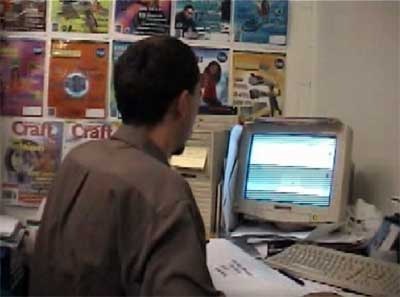
I was tidying a drawer full of old CDs when I came across one labeled “Music for a late nightâ€. Finding that CD took me back several years to when my then business partner Tom and I had a small office in the beachside Sydney suburb of Coogee, where we put together our magazine FREE ACCESS.
I created the CD to have something to listen to when we were working late into the night to meet a deadline. It was eclectic collection of music, everything from Pink Floyd to Nirvana to Lou Reed.
Somehow, without fail, Tom and I always found ourselves working on the two weekends before the magazine went to the printers. Often on the second weekend we’d work right through the nights in order to meet our deadline. It would take us at least a week to recover from the stress and the sleep deprivation.
Our little office was above a chemist shop. It had just enough space for a large desk for Tom and myself, and a separate desk for our assistant Julieanne , who by the way, rightly, worked nine to five, weekdays.
Our office had no windows, so that while we were located in one of the most scenic areas of Sydney, most of our days were spent within the confines of our small office under an electric light.
On those late nights when Tom and I toiled behind our computer screens, it was almost like being in a cocoon that separated us, or maybe protected us, from the drunken revelers partying in the nearby pubs and clubs. That’s probably a good metaphor for the world that Tom and I created, where the magazine was our own madly compelling, but somewhat limited cocoon, that all at once broadened our horizons, and also narrowed them.
In time we came to see that our vision was flawed, and no matter how hard we worked, we would never get to where were we really wanted to go.
Having said all of that, and notwithsanding how demanding those times were both physically and mentally, there’s something about those late night marathons I still miss. It’s hard to put my finger on exactly what that is exactly; perhaps it was the camaraderie, a shared sense of destiny, or maybe it was just the comfort of being in a cocoon.
Now that I reflect on that time of my life, I have mixed feelings. On the one hand going into business with Tom was one of the greatest adventures of my life. On the other hand, I can’t help wondering whether those crazy years could have been better spent.
I suspect that as even more years go past, I’ll be able to see more clearly just how formative those years actually were. Not just from the point of view that I obviously needed to live through those years, and to have those experiences, to get where I am now – a place I’m very happy to be – but also because I learnt so many important lessons, which I’m grateful to have learnt while still relatively young, and able to make changes.
There are so many darker paths I could found myself on.

Both my father and I owe our existence to one young man’s quick thinking and luck on the morning of March 31, 1937 (or perhaps 1936). Below is a translation of the clipping pictured at the bottom of the page:
Crew of burning plane: Courageous landing at Olomovc Airport
At Olomovc Airport on the 31st of March, 19 witnesses described the fearless courage and skill of training plane pilot Lieutenant Frantisek Pospisil and his observer Corporal Josef Pipal.
The training plane took off before 10am that morning, and circled about nine hundred feet above Olomovc airport in heavy winds. Lieutenant Frantisek Pospisil noticed the lower part of the engine was on fire, and as the flames reached the cockpit burning his face and hands, the lieutenant stayed at his controls landing the plane in a nearby field next to the cemetery on Nova Street.
Within seconds of landing he managed to untangle himself , and only his quick reaction in a margin of two or three seconds, were factors that saved him and Corporal Pipal from a horrifying death.
Almost immediately both Lieutenant Pospisil and Corporal Pipal tried to stop the fire from spreading, even after the explosion of the fuel tank, but the task was beyond all hope. Even parts of the metal structure were burning. Immediately they were surrounded by crowds of onlookers willing to help save the plan, but it was beyond salvage.
After an accident debriefing, Lieutenant Pospisil returned to his headquarters, with his face and hand bandaged, he sent for his lunch, refusing to talk to anyone about the accident, expressing only how sorry he was to loose his beautiful plane.
The whole event did not change his attitude towards flying, he said, and he would resume his duties in a few days. His cheerful disposition reinforced the impression of a brave and dedicated pilot. There were no signs to indicate that just a short time ago he had only just escaped a very unpleasant death.
The partly burnt parachutes of both flyers were torn to small pieces by other pilots as good luck charms. The case of the fire is under army investigation.
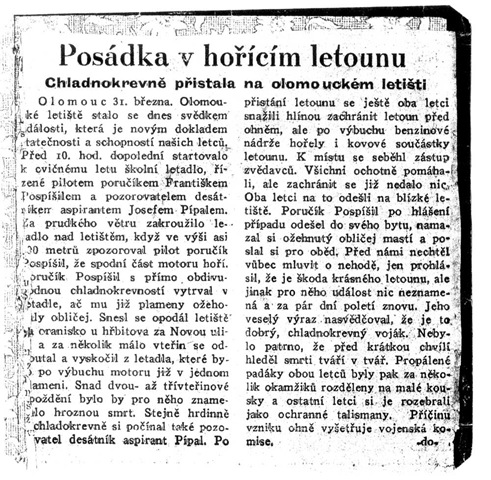
Incidentally, I never met grandfather Pospisil, he died in the 1940s at a relatively young age, but it sounds like he must have been quite an interesting character.
 My partner in this exercise, Hannah Pospisil eating a banana we had just bought during our morning walk in Lima
When the Pospisils were in Lima in November and December I would often take Hannah for a walk early in the morning. Going for a walk in Lima is an entirely different experience to talking a walk in say Sydney.
In the areas where we walked, around San Miguel, I never felt threatened by a person in any way. However, I can’t say the say the same about the traffic – which really is the biggest danger.
That aside, one idea that intrigues me is the idea of “the ordinaryâ€, or more precisely, the idea of actually looking at ordinary things rather than letting them slip into the background.
With this in mind I set out one morning with Hannah to take pictures of things that we saw on our way – both the ordinary and the odd. The only thing that ties these images together is that Hannah and I saw all of them on the morning of November 29, 2008.


